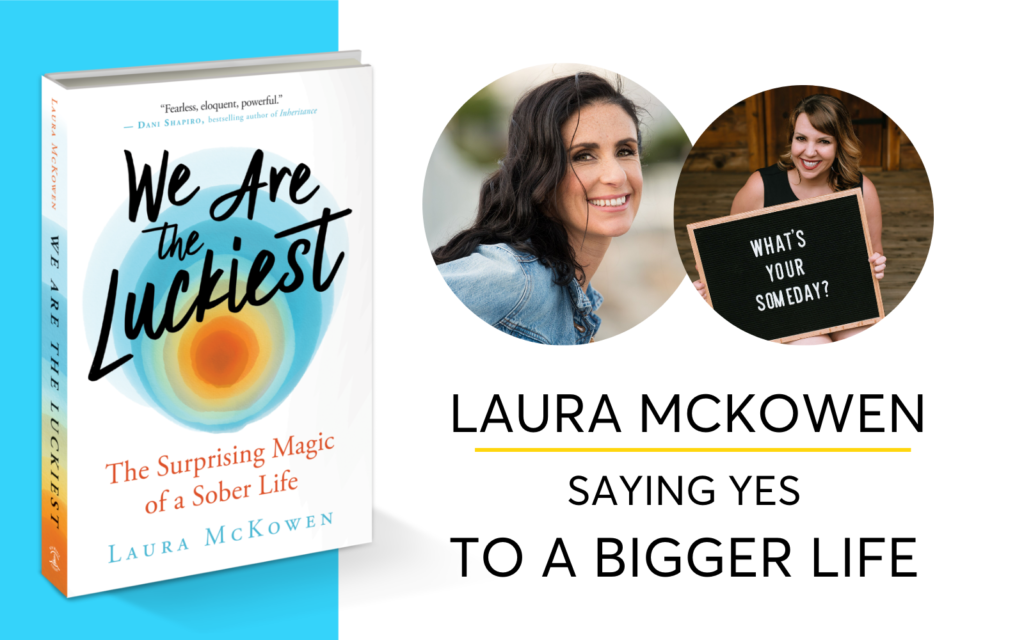
SOBRIETY CAN BE AN INVITATION TO WAKE UP TO OUR LIVES.
LAURA MCKOWEN SHOWS US HOW TO SAY YES TO A BIGGER LIFE.
In Laura McKowen’s memoir, We Are The Luckiest, she writes,
“There is a life that is calling you forward, begging you to meet its eye, to glimpse its vision for you. You can get only so far by running away from what you do not want. Eventually you will have to turn toward what you do. You will have to run toward a bigger yes.”
I invited Laura to join me on the podcast to talk about how to say yes to a bigger life and how to be more intentional about how they’re living.
Laura McCowen is the author of the book, We Are the Luckiest – The Surprising Magic of a Sober Life. Laura also writes an award winning blog and has hosted two incredible podcasts, Home and Spiritualish. She has been featured in The New York Times, The Guardian, Web MD Psychology Today, The Today Show and more.
Laura leads workshops with women and men to go deeper into learning about what is meaningful in their lives.
This work is valuable for anyone at any time, but is especially transformative for women who have stopped drinking or are re-evaluating their relationship with alcohol.
When you’re giving up drinking – and the space it occupies in your days, life, social circle and identity – it’s important to reflect on what else is meaningful to you and deeper callings you have.
This podcast and Laura’s work will speak to you if
- you desire a deeper sense of purpose in your life
- you dream about spending your days in a more connected, meaningful way
- you need clarity around a big life decision or relationship
- you know you’re not living into your potential, but don’t know how to get from “here” to “there”
- you’re tired of feeling depleted, disconnected, and alone
- you need to stoke your creativity and belief in possibility
- you want to create or deepen your spiritual practice
In this episode, Laura and I discuss:
- How to say YES to a better life without alcohol
- Why to ask yourself big questions so that you’re not living an unconscious life
- How to listen to your inner voice and stop letting fear hold you back
- Why you often don’t need to do a big thing or make huge changes in your job or relationships to find more happiness in your life
- Practices to gain more clarity around what you want and intentional about how you’re living
- How to find meaning and appreciation in what you already have
- Why drinking keeps you stuck
- How to live in alignment with your core values
About Laura McKowen
Laura had a long successful career in public relations, and the madman esque drinking culture of advertising. After getting sober she became recognized as a fresh voice and recovery. Beloved, for her soulful and irreverent writing, online and in print. Laura is the founder of several online programs for sobriety and personal development, teaching people how to say yes to a bigger life, and founded the luckiest club, a sobriety support community.
Resources & Links Mentioned
Learn more about Laura McKowen and how she supports women who want to quit drinking, head over to lauramckowen.com
Follow Laura on her journey living alcohol free, to subscribe to her blog
Purchase her book, We Are The Luckiest: The Surprising Magic of a Sober Life
Support, resources and tools to help you go alcohol-free
Drink Less + Live More today with The Sobriety Starter Kit. The private, on-demand coaching course you need to break out of the drinking cycle – without white-knuckling it or hating the process.
Grab the Free 30-Day Guide To Quitting Drinking, 30 Tips For Your First Month Alcohol-Free
Find out more about Casey and her coaching programs, head over to her website, www.hellosomedaycoaching.com
Connect with Casey
Take a screenshot of your favorite episode, post it on your Instagram and tag me @caseymdavidson and tell me your biggest takeaway!
Want to read the full transcript of this podcast episode? Scroll down on this page.
READ THE TRANSCRIPT OF THIS PODCAST INTERVIEW
Saying Yes To A Bigger Life with Laura McKowen
SUMMARY KEYWORDS
drinking, quit, people, life, sobriety, work, sober, living, questions, big, feel, week, book, women, Laura, explore, process, dharma, job, listening, roles, faith, religious trauma, creating a space where we can intentionally explore, outer circumstances, , self-discovery, there’s a life that’s calling you forward, begging you to meet it, it’s not our darkness that we fear, but our light, meditation
SPEAKERS: Casey McGuire Davidson + Laura McKowen
00:02
Welcome to the Hello Someday Podcast, the podcast for busy women who are ready to drink less and live more. I’m Casey McGuire Davidson, ex-red wine girl turned life coach helping women create lives they love without alcohol. But it wasn’t that long ago that I was anxious, overwhelmed, and drinking a bottle of wine and night to unwind. I thought that wine was the glue, holding my life together, helping me cope with my kids, my stressful job and my busy life. I didn’t realize that my love affair with drinking was making me more anxious and less able to manage my responsibilities.
In this podcast, my goal is to teach you the tried and true secrets of creating and living a life you don’t want to escape from.
Each week, I’ll bring you tools, lessons and conversations to help you drink less and live more. I’ll teach you how to navigate our drinking obsessed culture without a bus, how to sit with your emotions, when you’re lonely or angry, frustrated or overwhelmed, how to self soothe without a drink, and how to turn the decision to stop drinking from your worst case scenario to the best decision of your life.
I am so glad you’re here. Now let’s get started.
My guest today is Laura McKowen, the author of the book, We Are The Luckiest, the surprising magic of a sober life. Laura writes an award-winning blog has hosted two incredible podcasts, home and spiritual, and has been featured in The New York Times, The Guardian, Web MD Psychology Today, the Today’s Show and more. Laura had a long successful career in public relations, and the madman drinking culture of advertising. After getting sober she became recognized as a fresh voice and recovery. Beloved, for her soulful and irreverent writing, online and in print. Laura is the founder of several online programs for sobriety and personal development, teaching people how to say yes to a bigger life, and founded The Luckiest Club, a Sobriety Support Community. So, Laura, welcome.
Thank you. Thank you so much. I’m so excited.
You could come on here because I told you just before we jumped on that five years ago, when I was Yes, in the few weeks before quitting drinking, I used to go walking and listen to you and Holly on the Home podcast.
02:38
Yeah, that’s so it’s so awesome. I love hearing that. And now it’s been five years later. It’s five years later.
02:45
Here we are on time. No, I loved your book. I know so many women listening to this absolutely loved We are the luckiest. So, thank you for writing that. Yeah, thank you.
02:57
Oh, thank you. I feel grateful to have had the opportunity to have a book out there in the world. It’s, it was a big dream of mine. So yeah, it’s strange to remember sometimes I remember like, Oh, yeah, there’s a whole story out there about, you know, my life, but it’s great.
Casey McGuire Davidson 03:16
Yeah. And I know you do so much work with women in early sobriety, who are in the process of stopping drinking. But you also do this whole other part of work about saying yes to a bigger life.
03:31
Yeah, I started it started as like, a workshop. Like when I first quit my career in Advertising. I’m a yoga teacher, I have been for a long time. And I was like, Okay, what can I do? You know, when I quit my career, and I started teaching these yoga workshops. And it started out as a three, four-hour workshop. And then I realized, like, Oh, my God, this is so much content. So, I created a class. So now it’s a class and it comes from this idea that, for me, and for a lot of people, you know, sobriety is this invitation to wake up to our lives. And a lot of times we find that we aren’t living the way that we really want to live, you know, some, whether it’s relationships, or our career, our job, our you know, he or even just our values, we’ve never really thought about our values and how if we’re living, according to them, you know, for a lot in alignment that way. So, it’s really about taking people through a process of exploring that and it’s just so nice to also have a space where you can ask yourself these big questions, right? We don’t typically do that. Yeah, we sort of save it nice, small moments of our lives or just before we go to bed at night or You know, in the shower or whatever it is that we take time to sort of have a, you know, well, a lot of times we say, Well, I don’t know what I want to be doing. But it’s not this, you know, like this, this can’t be it. But we don’t really take time to explore that. So, it’s fun. sobriety is just like a beginning, as you know.
05:20
Yeah. No, I love that. One of my, one of my friends here in the local Seattle area, said she took your course the bigger Yes, she actually did it. During quarantine, she and her family were driving an RV across the country. While working and having your kids do you know that I know. I knew she is. Yeah, you know, she is. Yeah, it was.
05:44
Yeah. Well, I get that story. I know that she I know who it is, because that’s not something you hear every day.
Casey McGuire Davidson 05:50
Yeah. And she said it was really life changing. Like it was incredible to do the work and to turn inward and get clear about what she wanted out of her life and her marriage and sort of touch base with that. So, I thought that was, you know, an incredible thing for her to do during this crazy time period.
06:08
Yeah, it’s so wild. Because I taught it. I think the last time I taught it was at the end of last year, yeah, and the fall of are in the late fall of 2020. And I thought, not many people are gonna want to take this, like, no one has time for this type of thing. And it was the most enrollment we’ve ever had, I think because people are having a sort of reckoning with their lives. I know I have in a lot of ways. Yeah. So it was it. That’s cool that she that she did it during now in an RV. And it’s so nice to ask ourselves these big questions. I mean, sometimes it’s not nice. Sometimes it’s really uncomfortable, because we kind of know that we’re not living the way we want to live. Right.
06:55
well, I mean, I know exactly what you mean. Because when I talk to women, and before I started working in sobriety, I worked at L’Oréal in marketing and advertising, okay. And I mean, I swear, every woman in corporate America needs Life Coaching and nieces work, because you’re doing all the things you’re supposed to do. And yet you’re like, why aren’t I happy?
Yeah. Right.
So, trying to get that, and a lot of times, it’s not, I think everybody could, I mean, everybody should take, you know, should ask themselves these questions, because otherwise, you end up living a pretty unconscious life. A lot of times what people discover is not that they need to do this big thing, you know, they don’t need to have some grand accomplishment. And it’s not about, you know, hitting the eject button on their life in a big way, whether it’s their relationship or their career, you know, a lot of people think that’s what they want. And what they really want is to find meaning in what they have, right, like, appreciate what they have, and to be more intentional with how they’re living. And this, and I love when that happens, you know, because our lives, not everyone is supposed to, or wants to ultimately have these massive, you know, accomplishments, like, that’s not really the definition of success for a lot of people, or they think it is and then that they do that, and it doesn’t work out, you know, it doesn’t give them what they want it, which is meaning like, that’s what we all want, we want meaning. It’s a tricky thing to aim at.
Casey McGuire Davidson 08:39
So, how do you take women through that process? Because I know the work you do is pretty structured in terms of the steps to get to that meaning or what they want in their lives?
08:50
Yeah, I do. It’s, of course, open to all genders and identification. So, it’s not just women, but it’s almost all women that take the course. I wish there were more men that did this type of work. And every now and it will get like, you know, 510 percent men on a good day in any of my programs. I wish it was more. But the structure is quite simple, actually. The course is six topics over seven weeks. And we start with having them take an inventory really of their life as it is. It is pretty structured. But it’s purposely simple. And there’s, you know, I emphasize, at least in this course especially, but in everything I teach that this is really like I’m not giving you the answers. I don’t know the answers for you. I’m just facilitating your process and give, give people guidelines to you know, and really a lot of questions for them to answer internally.
So, the first topic we get into is faith. And it’s always a tricky word for some people and to approach this topic of faith, because a lot of people, some people have religious trauma. But more than that, it’s just not everyone identifies with having faith, you know. And so, I talk about what that word actually means. And really in, in sort of a mindset way, you know, are you Do you believe in scarcity? Or abundance? Do you believe in? You know, do you really live with a lot of doubt? Or do you have trust that things will come to you and that you get what you need and that type of thing. So, we explore a lot of that, and that the entry point and then we then we go into week 2 is truth. And that’s really looking at your life as it is kind of examining at the very, you know, this is a very high overview, but what what’s working what’s not. And then the 3rd week is clarity. And the 4th week is alignment. And the 5th week is devotion. And then 6th week is integration. So, as you kind of go, you do a lot of looking back in the first few weeks, and then a lot of looking forward in the in the second half of the class. And one of the things I do is to get people in their bodies. So a lot of you know, this isn’t know what I try to instill in people is like, you’re more than these thoughts that you have, like, that’s one part of you your mind, but you actually have several voices, so to speak inside of you, you have an emotional language that you can tap into and listen to and understand. And you have a body, and our bodies are incredibly wise and hold every experience we’ve ever had. And we in Western culture, but also particularly in women are very disconnected from our bodies, we sort of demonize them or just think of them as like these machines that can just keep going and we want to manipulate them or shrink them. Or, you know, I know for me, I had a lot of disconnection from my body. And for people who have gone through addiction, which a lot of people in my class my courses have in this course, they’re really disconnected from their body. And when you’re disconnected from your body, you’re really disconnected from this really beautiful source of inner wisdom. So every week, there’s a body component, a movement component, I also incorporate music, I incorporate a lot of literature and poetry, and beautiful, you know, words that I’ve drawn inspiration from, and then there’s a lot of self-inquiry, they get homework every week. And the idea is that I believe we are the best they are the experts on us, you know, you’re the expert on you. I’m not, I’m the expert on me. And that goes for everybody. And a lot of times it’s a matter of asking the right questions or opening the door for people to explore themselves. And that process is super revealing, if you allow it to be if you can get out of your own way. And maybe you know your egos way, I suppose you could say and allow yourself to ask difficult questions about what’s working and what’s not. And what do I really want? What do I really, really, really want, to me, this type of work is? So, I don’t really believe that our sort of unused potential is a benign thing. Like it doesn’t just if we don’t use it, it doesn’t just sort of sit there and nothing much happens. I think a lot of the pain for me of addiction. And a lot of the pain that a lot of people are in are a result of knowing we could be more than we are and we’re not doing it. We could live differently and more in alignment with who we are we could have more we could and I don’t mean material things but we could live into our potential and I mean, you know what that feels like when you’re not doing it. It’s resentment and bitterness and depression and all those things.
Casey McGuire Davidson 14:39
If you’re listening to this episode and have been trying to take a break from drinking, but keep starting and stopping and starting again, I want to invite you to take a look at my on demand coaching course, The Sobriety Starter Kit. The Sobriety Starter Kit is an online self study, sober coaching course that will help you quit drinking and build a life you love without alcohol without white knuckling it or hating the process. The course includes the exact step-by-step coaching framework I work through with my private coaching clients, but at a much more affordable price than one-on-one coaching. And The Sobriety Starter Kit is ready, waiting and available to support you anytime you need it, when it fits into your schedule. You don’t need to work your life around group meetings or classes at a specific day or time. This course is not a 30 day challenge, or a one day at a time approach. Instead, it’s a step-by-step formula for changing your relationship with alcohol. The course will help you turn the decision to stop drinking from your worst case scenario to the best decision of your life. You will sleep better and have more energy, you’ll look better and feel better, you’ll have more patience and less anxiety. And with my approach you won’t feel deprived or isolated in the process. So if you’re interested in learning more about all the details, please go to www.sobrietystarterkit.com. You can start at any time and I would love to see you in the course.
To me, it’s not just means to your body, you know, because a lot of people I think myself included for a long time were like, I don’t know what else I want. But I know I feel like you mentioned resentment, bitterness, depression, like you just feel like you have this crushing weight on your shoulders. But especially when you’re drinking, you can’t imagine what else there could be you’re sort of trapped in what is right.
17:08
Well, yeah, and drinking, is it you know, drinking keeps you stuck, period. It just well. I think Carolyn that said in drinking the left story is like, when you stop drinking, you stop waiting. And that was true for me. So yeah. And I don’t mean to say depression is always caused by is always in our own, you know, in our capability to just fix by living differently, because sometimes it’s not. But a lot of times the way that we are living and the choices that we are making in our circumstances, and there’s all these layers of things, some of which we don’t have control over, but some of which we do that. Yeah, that can lead to depression, and definitely resentment and bitterness. And because we know, we could we were not what we could be. And that’s a crushing feeling. Right? To know that you’re, for me. It was a disconnect from that disconnect from my possibility was like, dangerous for me. It was deeply paid, because it’s so painful.
Casey McGuire Davidson 18:24
One, then I know a lot of women sit there and, and wonder should you know, shouldn’t I just be happy with what I have? Should I just yeah. And so that’s a big hurdle to overcome.
Totally.
18:37
Yes. A lot of people feel that way. I have felt that way. And, you know, a lot of that is sort of, because we’ve been living according to what someone else’s idea of a meaningful successful life is, right. And when that doesn’t, we’ve been following the blueprint that we saw on Disney movies, or that our parents told us or that society told us we should be pursuing and when that doesn’t pay off. And we still find ourselves miserable. That’s a deep disappointment. And it’s like, What’s wrong with me? You know, and it’s not that anything’s wrong with you. Usually, it’s that you are living according to someone else’s playbook. And in a lot of times, people don’t realize that, you know, it’s like, there’s an unconsciousness, just, there’s, there’s this like, I’m miserable. And I don’t know why it doesn’t matter what I do. It seems I’m still left with me, and why am I unhappy? Yeah.
Casey McGuire Davidson 19:48
So, where’s the place that people usually need to start with questions? You know, I think for me, it’s simply being asked the right questions. And exploring those honestly. Whether it’s in writing, I encourage a lot of writing. Just, you know, handwriting, journal type writing, or in conversation. That’s the starting point, just having someone ask the right questions or ask any questions, like, what do you want? is a big question. And you’ll hear a lot of people say, I don’t know, but they do know. They at least know it’s not this. A lot of times you know that. That’s, that’s a start. But a lot of people will say they don’t know what they want. But what they really mean is they don’t they’re afraid to say what they want. Because Yeah, who am I to want that? Or what if I want that? What does that mean for my life?
Casey McGuire Davidson 20:53
Yeah, that’s a big one. Right? If I want that, what does that mean? For everything I built right around me. Right. I heard honestly, that, not this, on another podcast, and I thought that was really great. As a place to start. It’s not me, by the way. It’s Gilbert. No, no, no. I mean, I’m sure lots of people said not this. But Elizabeth Gilbert wrote this, you should link it up. This incredible. It was actually a Facebook post, it might be, I think she turned it into like a blog type post. It’s an essay, it’s a short essay, called not this. And it was published several years ago. And it’s brilliant, because it provides that really accessible starting point, like a lot of times we don’t exactly know where we’re going. But we know, it’s not this, this is not, it’s not, not here, not this relationship, not this job, not this whatever, that there’s another side to that, too. And this is more what I’m curious about people exploring is, the outer circumstances are always are one thing. But you could find all different kinds of relationships, and all different kinds of places to live and jobs. And I did all that, you know, that just jumping around and relocating and dating new people and switching jobs when I was bored, or uncomfortable or whatever, you’re still left with you. So, a lot of this is acceptance, and getting to know yourself. Like, who? Who am I? Who is this person when you get sober? Like, that’s a big question. A lot of people don’t know what they like, how they want to spend their time. Yeah, you know, what their preferences are? What? Especially I know, notice mothers and women, especially mothers, I would say, because they get really lost in the role of being in service to others. They, they don’t know who they are, they lose sight of themselves.
Casey McGuire Davidson 22:56
And I remember when I quit drinking, the big question was like, what do I actually like, more than wine? And I was sort of at a loss to answer that. Yeah, I would say hard. How do you fill up that time?
23:11
Yeah, like, what, what do I do now? What? What do I enjoy? What’s fun?
Casey McGuire Davidson 23:16
You know, what’s, how do I have conversations? How do I go on a date? How do I? Yeah, all those things. And that’s part of it too, you know, is just creating a space where we can intentionally explore that, that those questions is what I prefer provide, or what I teach in that in that class, really, any of the classes, you know, I think so much of it is just creating the space to do these things to ask these questions to do this work.
23:50
Yeah. I loved you at a quote. And I think it’s in your book about The Bigger Yes, that there’s a life that’s calling you forward, begging you to meet it. Sigh. Tell me more about that. Like, how do you encourage people through the class to say, Okay, what is that bigger thing for you, even if it’s, you know, internal meaning or finding meaning in what you do every day?
24:14
Yeah, I mean, it that is the process of the class really is taking them through the inquiry and self-discovery. To reveal some things to themselves. Some of it is exploration of values, some of it is looking back on who you were when you were a child. And what interested you and what sparked your attention and your, you know, before you had ideas about what was right or wrong to be doing or liking. Some of it is looking at the totality of your life to this point and saying what’s missing, like what would I be uncovered? Believing that if I if things were to end tomorrow, what am I unwilling to leave out of this story? I mean, for me, that was huge. It was like, I’m unwilling to not do too. I want to I’m going to publish a book, I’m gonna, there’s no way. I mean, even before I got sober, I would think, to the end and think like, is this my story that I just don’t get sober? Like, no. And, and to force those questions, and then having people explore themselves from a non-sort of traditional identity role, you know, you’re not just the roles that you have mother, occupation, wife, partner, friends, sister, but like, who and your essence, who are you, you know, and getting people to think about that. And that’s always really powerful, too. And there’s a whole exercise I take them through, but like, you’re not be beneath all the roles that you play, who’s under there? What’s the essence of who’s under there? And that’s really powerful, too, because we don’t consider who we are outside of our roles very often.
No, I don’t, that you have to purposely do that. And so, it’s kind of this partially cerebral process of thinking and exploring, and partially this embodied process of just opening the door to be in tune with your, with the wisdom in your body. And for some people that comes very easily, and they’re already there, you know, they do that type of work. And for some people, that’s like, a completely unknown, uncharted territory, you know, it is mind blowing, when they get in a couple different yoga poses and listen to, to certain songs and ask their themselves questions. It’s like, you know, the waterworks, and the surge of different emotions and memories, and all that. So, it’s partially cerebral, it’s partially embodied. And then there’s a lot of intuition that comes in there, you know, and sort of I, my belief is that I co create, I believe in a god. I call, I say, God, but I believe in it. Higher Power, and, and that I, you know, this isn’t all random.
Yeah, just floating along at random. And so, cultivating that type of relationship is another piece of it, you know, when we, that, that for a lot of people, I forget that all the time, like, I don’t have to force I’m part of a much larger, larger ecosystem, you know, that starts here, but in my, and then in my home, and then in my community, and then it extends outward, and then, you know, it includes everyone and everything. When you think about it like that. It’s like, Okay, so what’s my role to play? And a lot of people just don’t even… they have this longing, or this sort of scratch this voice that scratched at them. But they, they think, who am I to, like, have some big dream? Who am I to think that I play an important part in this world? There’s a lot of that. Like, that’s really wonder if that’s what you should like, pay attention when you hear that voice saying who?
Absolutely, that’s Yes. Yeah.
28:45
Yes. Yeah, that is that small voice is very wise has a lot to say. I think that’s like a soul voice, you know, we’re, we get a lot of instruction that way that we just totally ignore, because, or that’s like, the resistance to get something that you really want, but then you’re sort of pulling yourself back, because of all the fears about what it would mean, or what people would think or what if you fail? All that stuff, right?
29:13
Yeah. And so, we talk a lot about that, too, you know, like, who are you not to? Marianne Williamson has that great passage, you know, where, it’s not our darkness that we fear, but our light. And I think that’s absolutely true. A lot of people like self-included, feared the light, the bigness that we felt inside of us much more than the heavy dark feelings.
29:37
What do you think was the biggest thing you feared in that like, what was, I don’t know? I think I didn’t know. It’s a lot of energy for me. It’s big energy like, it feels frightening.
Yeah, there was a lot of it’s the energy of sort of creation, you know that it can feel very scary.
Casey McGuire Davidson 30:12
Yeah.
Yeah. I don’t know how else to put it. That’s how it feels it felt it feels to me. Because it’s like, what is this want for me? What am I? If I’m going to follow this? What’s going to happen?
30:25
Yeah, it’s the unknown. Yeah. I mean, a lot of this kind of, you know, follow the prescribed steps of, you know, college job, promotions kids house. And then it’s kind of scary to even ask the questions of, is this what I want? And? And if not, what does that mean?
30:49
Absolutely, no, it’s, it’s super scary. And it means a lot of times, you know, people have to go against the wishes of people that have cared for them, and provided for them or go against what people want for them goes against what they’ve agreed to be, you know, and in this life, and what they the contracts they’ve made with people and all the relationships and yeah, it’s, it can be quite terrifying. I mean, as someone who switched careers that 37 and the single mom is like, who does this? But a lot of people do. Yes, a thing a lot of people do. It’s possible. I had people championing me and you know, that’s another piece of it is just hearing other people going through a similar process is always really helpful. And that’s something that’s cool. That happens and classes like that, where you realize, oh, Allah Terry experience.
31:55
Yeah. And you realize, like, Oh, I have this, that people like, we all have the same fears, and the same feelings and the same worries and the same stories, that we’re telling ourselves about what’s possible or not possible. Especially. Yeah. Like, what if I dropped all that? There’s the potential to be totally surprised. By life, and by myself.
Casey McGuire Davidson 32:21
One I think what’s nice is starting with exploration, because a lot of us don’t know what the end answer is or scared of what that will be. So, we stop ourselves from ever asking the question.
32:35
Yeah, exactly. Yeah. It’s just which is so. So unfortunate.
32:42
Yeah. Yeah. And I want to point something, I wanted to talk about this, because I feel like once you stop drinking, you know, drinking keeps your goals and your expectations pretty low. It and as you’re checking out every night, and you’re, kind of, like, recovering every morning. So, you’re really spending a lot of time treading water and beating yourself up. So, I feel like we put up with a lot of shit that you wouldn’t normally and suddenly you’ve stopped drinking, and all the shit that you drank over is still there. And something has to give like, you’re suddenly left without your like, film around you. And your leg out. Oh, shit. If I don’t change something, I will probably go back to drinking because this is sort of anti hon.
33:28
Yeah, this this being out of alignment with my “self”. Really what it is, is very painful. Very painful. Yeah, that’s, it does require that we change or, you know, live sort of miserably sober. Just like,
terrible good either.
33:52
No, it’s no good. Yeah. When we’re drinking, we just kind of stay in survival mode.
33:58
Yeah. And we get out of that more like, our life. It’s like, the water gets clear. And you’re like, Oh, I see everything now underneath.
But that’s the stuff right, that you’re finally able to look at stuff and make changes.
34:15
It is good, but it doesn’t feel good. Yeah, it doesn’t always feel good. It actually feels to a lot of people horrible to face all that. And even if you know even if it’s like, not like you’ve created because a lot of people stop drinking before you know they don’t I have a ton of wreckage, right? A lot of people don’t. But they have that same sort of reckoning where they stopped drinking and their life is now visible to them and their feelings are available to them. And that can be quite the shock. can be quite the shock. Yeah.
34:51
I thought it was interesting because my friend who I was talking to I asked her what made her decide to take your course and she said you know after she stopped Drinking, she sort of looked around and said, Okay, what am I doing? Is this it? What’s the purpose for doing all this? Like, I need more, but I need help figuring that out. And I thought that was very cool.
35:14
Yeah, it’s a very common. It’s a beautiful question. It’s a very common question someone I had, like, I kind of knew what direction I wanted to go, I guess. But I also was very lost. You know, we, of course we are. And I get a lot of people who take this sort of at a certain phase of life, too. You know, it’s not a lot of young, younger people. It’s like, people in their 40s 50s 60s, who have lived sort of a life already. And are like, Okay. This isn’t how I want to spend the rest. Yeah, my life.
Casey McGuire Davidson 36:00
I just when you were saying that I thought of Rene browns, like the midlife unraveling? Have you heard that? Yeah. The universe places her hands on your shoulder and says, you know, basically, I’m not fucking around anymore. Time is growing short.
Yeah. Yes. And that is, I mean, it’s so weird to me that I’m in middle age, but I know, you feel that way. But it’s really weird. And like, I still see myself as being so much younger, but my feelings about life. Y
Yeah, they’re not fucking around. This is definitely present. Yeah. And sobriety will do that to you, too. You know, I had the sense that I had wasted a lot of time, even though I hadn’t. I don’t really believe that was true. I think a lot of people spring out from drinking, and they’re like, Oh, God, now I need to make things make sense and make things right. Which is a great motivation. Why use it?
Casey McGuire Davidson 37:10
And what about struggling with sort of the idea of permission, right, sort of changing the status quo and the roles that, you know, sort of everyone in your life kind of bought into?
37:21
Yeah, I mean, my take on that is like, who, if you have the privilege to do this kind of work. And anyone who takes the course does have a certain amount of privilege. Just you have the resources you have WiFi you have? I can’t say that everybody’s life is easy, certainly. But you’re able to function you’re able to pay for a course you’re able to, to participate, you’re healthy enough, that type of thing, if you can do it, who are you? You better? That’s how I feel like who are you not to do that? Right, who are you not to play your part. Because ultimately, I think of it like, I talk a lot in the course, the course is based on a book called the great work of your life by Stephen cope, which is based on the Bhagavad Gita, which is an ancient text. And it’s really about Dharma, finding Dharma and Dharma in there’s many definitions of Dharma, but in yoga, you know, philosophy, it’s, it’s sort of referred, it’s truth, you know, truth or the way. And Dharma is in yogi philosophy deem to be something blueprinted on you, it’s not something that you make up, it’s something inside of you. And you, your responsibility, is to live into it. And that everybody has a Dharma, right? Everyone has a purpose or a unique blueprint inside of them. And I always say, like, humans, are the only people are the only species that are really confused about their Dharma, right? You don’t see, like cats trying to be dogs or birds, you know, jealous of the dogs because they want to, you know, be on the ground. You know, digging holes versus flying, you know, frogs aren’t confused, they all have a place. And humans are the ones that get it. You know, this is silly. It’s a silly but sort of metaphor, but it works because humans get all twisted up. And we have these minds, these beautiful minds, but they’re also like, create a lot of bullshit stories. You know, and like things like I need permission. It’s like but you this is who you are. If this is who you are. Your job is to be who you are like that is the primary job that you have. Right? And by doing that, this is the important part. By doing that, by becoming who you are, and fulfilling your potential to the best of your ability, you are an app you are in service to other people, you are in service to the greater ecosystem, right? You’re playing your part. So, the permission thing, that’s how I answer it, it’s like, you don’t just have permission, but you kind of have a responsibility, you have a duty to play your part. You know, this isn’t just like fun and games, like, I really do believe that, that our unused potential or our, if we aren’t playing our parts, so to speak, that creates a lot of pain and bitterness and resentment, it’s not a benign thing at all. It doesn’t just go away; it creates a lot of pain and darkness.
40:50
So do you feel like at the end of this process, people come away with the tools where not only are they sort of living with greater meaning, but if they start to feel that bitterness, that resentment, they they kind of can dig into that to resolve that more quickly?
41:06
I look at it, I mean, look, nobody’s entire life gets fixed or set, the course can be changed, but nobody’s life gets fixed in six weeks or seven weeks, but I look at it as like, planting seeds. Like, there’s seeds in there that you can use and grow and tend to and that you get to keep as tools. Yes. And, and insight and awareness, if you’re willing to look at it and take it that will that can change the course of your life. So, I guess that the answer is yes. But I wouldn’t say that after six or seven weeks, people, you know, go walking into the sunlight, and they’re getting dressed by blue birds and everything makes sense. You know, it’s not like that. I think a lot of people often leave with a lot more questions than answers, but that’s good. You know, it’s like, they’ve, they finally have the permission to a lot of times go after what they want. And to see themselves in a different light, to see their experience of their life in a different light, you know, perspective can be everything. And I tried to help them achieve that for themselves to get a shift in perspective. So yeah, I think ultimately, they leave with a lot of questions, important questions, maybe a few answers. A lot of times people don’t leave with what they think they were going to leave with. Everyone comes in thinking, I need a new job, you know, I really want Oh, yeah, I need a new job. I hate my job. And a lot of times, we believe going, No, that’s not wrong. But this is it. I want to I want to live more intentionally here. Sometimes people do want to change their job. But all the time. You know, it’s cool, because I have people take the class multiple times, that happens a lot. And like, even just yesterday, someone posted, one of the students that had taken it a couple times posted on Facebook, that she had started a company that she had talked about the ideas for in the bigger Yes, a few years ago. I was like, I love that. I love seeing that. You know, sometimes it’s a company, sometimes it’s just a different way of moving through the world through their life. Yeah.
Casey McGuire Davidson 43:36
Are there any practices that you do sort of every day or every week that help you?
43:41
Yeah, I’m a big, huge fan of mourning pages. It’s a practice that Julia Cameron developed in the artists way. I do that every morning. And it’s just free writing automatic writing, she calls it we just dump your thoughts. You can look it up online, the artists way is a beautiful book. I do that I’ve just had a habit of doing that I am have finally become a consistent meditator. And I think that that’s a really impactful tool.
44:14
Did it take you a while to do that? Because for five years, I think I should meditate.
44:19
Yeah, it took me about six years. So, I mean, I there’s no yeah, there’s totally hope I finally did it because I just been telling myself that for so long. And when I would do it, I would feel shifts, but I just never stuck with it. And I’ve been spending a lot of time listening to Sam Harris in the past year. He talks a lot about meditation, and then I have a coach now who hit meditation for him is the absolute number one, sort of, that’s his baseline. You know, he’s sober also and says like, that is his bedrock is meditation practice. So, I was like, Alright 2021 is the year I develop a consistent meditation practice and I have. So far, it’s been great. You know, it’s interesting, because now that I’m doing it consistently, it’s a lot like, sort of sobriety where it doesn’t feel that great. Initially, like, at all, it actually brings up a lot of junk. But luckily, I have people to ask, like, Is this normal? Like, that’s what happens. Like my tolerance for caffeine is like nothing now that I’ve started meditating like weird shit like that. Oh, that’s interesting. How long do you meditate every day? 10 minutes? 20 minutes? Like, not anything? No, no superhero meditating. It’s basic stuff. But yeah…
45:52
Yeah, I was like, why can I not stand more than a cup of coffee? Like, I usually was a three cup, you know, a day type of person. I can barely tolerate the one my anxiety just goes, so? And my coach was like, Oh, yeah, that’s totally normal. rotation and caffeine. Don’t go they are friends. Like god dammit. Why? Why do we do this?
46:17
Can I have nothing? I’ve already stopped drinking. Can I have nothing? So I can have nice things ever. Yeah. Okay, so morning pages and meditation, anything else that you feel like is a
46:31
no, for me that I mean, I, I’m a sleep. Like, I take sleep super seriously. So for me, that is a I get eight hours of sleep, like religiously. I mean, sometimes I don’t, but it’s but I try. It’s not for lack of being in bed. It’s like, I’ll just have a bad night of sleep, be restless. But sleep is a huge thing for me. Those are, that’s it? I think, you know, you hear like these really intricate long, you know, morning practices. And this is these are the 15 things you have to do every day to change your life. And it just isn’t sustainable. For me. It’s like very simple practices, I have to keep things very simple and small. And then you build, right because it used to just be, I’m not gonna drink today. And it was everything I could do to not drink today. And I don’t have to think about that anymore, ever. But that took a while, you know, so you build these smaller habits? And then and then you can they have compound interest? Yeah, in your life?
47:39
Well, I loved what you said originally. And I feel like everything since then sort of built on how you get to this with the idea of just living in alignment with your core values or with who you were meant to be. And being intentional in that. So, you’re not fighting that all the time.
47:56
Yeah, I mean, a way of thinking about being intentional, because it’s a big leap to go like, Am I living exactly the way I want? I mean, most people would say no, I would say no, let’s not ever exact, it’s a process. But a big sort of tip-off is like, is what I think, what I feel, and what I do the same, in the same vein, you know, are those things align? Or is what I think and what I say, and what I do, very different? That’s being out of alignment, right? I say I want these things, but I don’t really want them, I hate them. You know, I’m around these people. And I don’t like them. I say I want to exercise more take care of my body or eat better, or whatever it is. And I don’t like my actions aren’t there. So that’s misalignment, right? I say I want to write a book, which I said forever, but yet, I go to this job every single day that I pretty much hate. Like that’s being out of alignment. And the first thing is just to notice, okay, I didn’t really say why morning pages is helpful. I find that helpful, because you have to approach it correctly. And it’s not rocket science, but it does take some practice because it’s unconscious writing, you’re not trying to solve a problem you’re literally putting on paper what comes into your mind as it comes. So, it’s very unedited, messy, no punctuation. No, it doesn’t make much sense. You’re not you know, it’s certainly never anything you would show anybody. It pulls up a lot of our subconscious and so we start to see things hear things in our words that are interesting. We start to see patterns. It also is like I call it like taking out the trash. You’re like taking out the trash in the morning. So, you’re not operating with all this junk in your mind.
You know the best, most cathartic morning pages I have are when I’m really pissed off. And I just need to say all the nasty unspiritual that needs to come out. Right? Put it on paper. And then it there’s a huge release doing that. Yeah. So that’s why it’s helpful. And as you do that, you start to get closer to yourself. And unmasking a slow sort of unmasking, and it’s just you in the paper. Not, you know, you don’t have to sit there and tell someone or anything like that you can just have this relationship with the, the page.
Casey McGuire Davidson 50:43
Yeah, okay, you’ve convinced me, I think I’m gonna go start doing that on a regular basis.
50:50
It’s great. I really love it. And it’s like, I just do one, you know, sort of big page every day and takes 10 minutes. And it’s really, I noticed when I don’t do it, I feel not as well. Yeah.
51:03
Well, so I know, people are gonna want to follow up with you. And I could summarize your programs. But I know you’ll do it so much better. So, will you share the work you do and how people can follow you?
51:15
Sure. So, my website is my name. It’s lauramckowen.com. I have my courses there. And my book, which you can buy anywhere books are sold, the courses that I teach now, there’s two one is The Bigger Yes, which we’ve been talking about. And the other one is called, We Are The Luckiest, which is the name of my book. The Course came out before the book did, but that is a sobriety program, like, not to, how to get sober, but how to sort of thrive in sobriety. And those are both online courses, the sobriety community that I started last year, the luckiest club is at the luckiest club calm, but you can find that my site and, on my website, too. And that’s a sobriety support community, we offer 23 meetings a week support meeting, on zoom, made a private community forum where you people can connect with each other. So, that’s for anybody any length of sobriety, sober, curious, you know, just thinking about getting sober or people that have you know, decades of sobriety. And they’re not AA meetings, they’re welcome all paths to recovery. So that’s what that is. And then, yeah, that’s really my work right now.
Casey McGuire Davidson 52:34
That’s great. Well, thank you so much for the work you do. I mean, your book was amazing. I know so many women who’ve read it and loved it, and it’s really touched them in a deep way more than many of the other books they’ve read. So, I think it’s incredible. And your home party. Back in the day, it helped me so much. Oh, my God. Yes. Well, thank you so much for being here. This is awesome.
Yeah. Thanks, Casey.
So thank you for coming on here. I couldn’t appreciate it more.
Thank you for listening to this episode of The Hello Someday Podcast. If you’re interested in learning more about me or the work I do or accessing free resources and guides to help you build a life you love without alcohol, please visit hellosomedaycoaching.com. And I would be so grateful if you would take a few minutes to rate and review this podcast so that more women can find it and join the conversation about drinking less and living more.
ABOUT THE HELLO SOMEDAY PODCAST
The Hello Someday Podcast helps busy and successful women build a life they love without alcohol. Host Casey McGuire Davidson, a certified life coach and creator of The Free 30-Day Guide to Quitting Drinking – 30 Tips For Your First Month Alcohol-Free, brings together her experience of quitting drinking while navigating work and motherhood, along with the voices of experts in personal development, self-care, addiction and recovery and self-improvement.
Whether you know you want to stop drinking and live an alcohol free life, are sober curious, or are in recovery this podcast is for you.
In each episode Casey will share the tried and true secrets of how to drink less and live more.
Learn how to let go of alcohol as a coping mechanism, how to shift your mindset about sobriety and change your drinking habits, how to create healthy routines to cope with anxiety, people pleasing and perfectionism, the importance of self-care in early sobriety, and why you don’t need to be an alcoholic to live an alcohol free life.
Be sure to grab the Free 30-Day Guide To Quitting Drinking right here.
Subscribe & Review in iTunes
Are you subscribed to my podcast? If you’re not, I want to encourage you to do that today. I don’t want you to miss an episode.
I’m adding a bunch of bonus episodes to the mix and if you’re not subscribed there’s a good chance you’ll miss out on those. Click here to subscribe in iTunes!
Now if you’re feeling extra loving, I would be really grateful if you left me a review over on iTunes, too. Those reviews help other people find my podcast and they’re also fun for me to go in and read. Just click here to review, select “Ratings and Reviews” and “Write a Review” and let me know what your favorite part of the podcast is. Thank you!